On this page
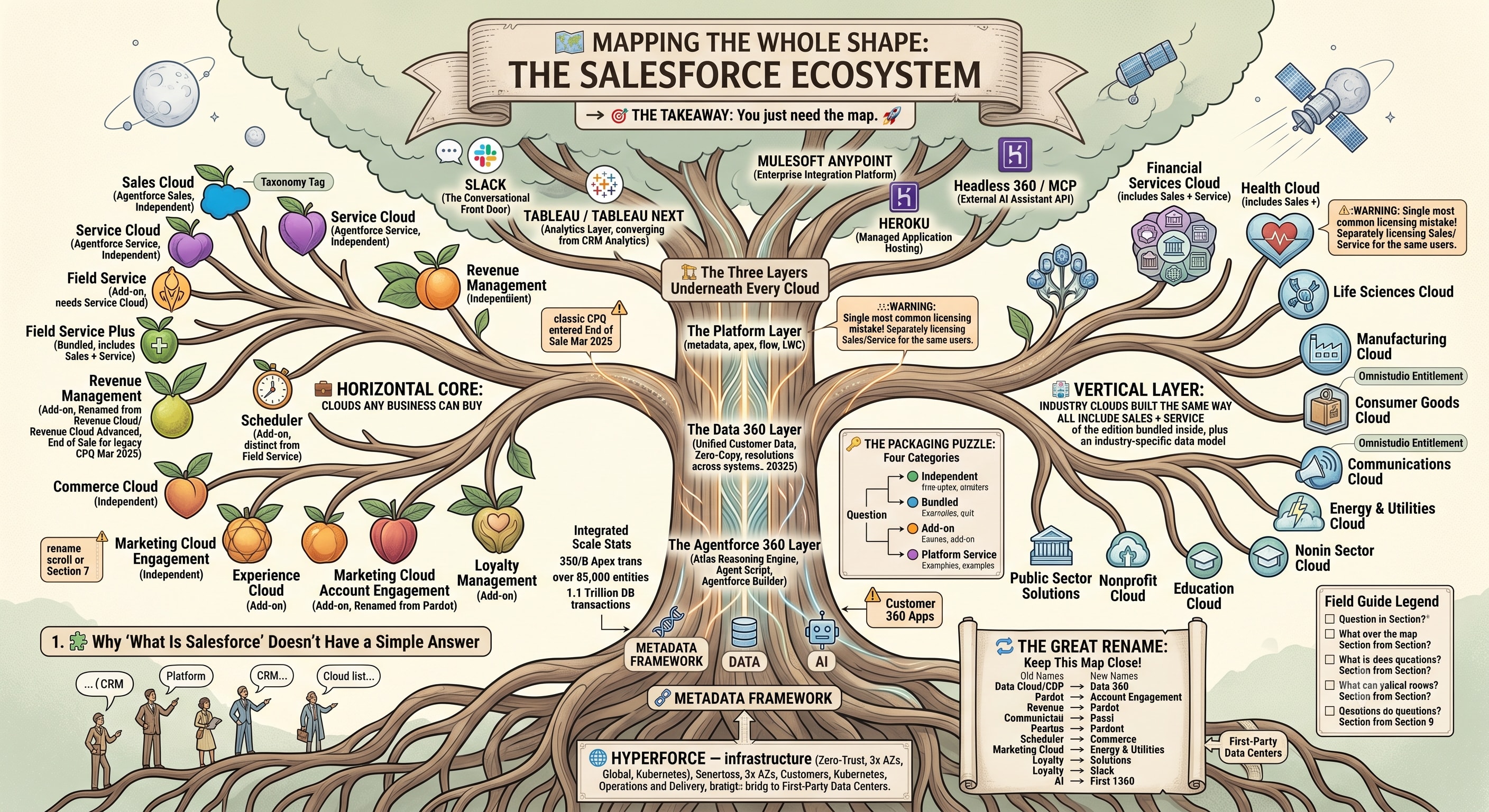
1. 🧩 Why "What Is Salesforce" Doesn't Have a Simple Answer#
Ask five Salesforce admins what Salesforce is and you'll get five different answers, and none of them will be wrong. One will say a CRM. Another will say a platform. A third will start listing clouds and trail off around number eight. That's not a knowledge gap — it's a genuine reflection of how sprawling the Salesforce ecosystem has become.
What started as a single sales-tracking app in 1999 is now a layered stack of horizontal clouds, industry-specific products, and infrastructure services, held together by a shared metadata engine and, as of late 2025, a shared agentic layer. Most practitioners know their corner of it well — the cloud they administer, the objects they customize — but rarely see the whole shape at once.
This is that whole shape. We'll go layer by layer: the platform underneath everything, the licensing patterns that determine what you're actually paying for, the clouds themselves (horizontal and vertical), and the infrastructure services that don't fit neatly into "a cloud" at all.
2. 🏗️ The Three Layers Underneath Every Cloud#
Before the clouds, there's the platform. Every Salesforce product — Sales Cloud, Health Cloud, Commerce Cloud, all of them — is built on the same three-layer foundation.
The Platform Layer#
This is the metadata engine: objects, fields, Apex, Flow, Lightning Web Components, the sharing model. It's what makes Salesforce a platform rather than just an app — the same declarative and programmatic tools you use to customize Sales Cloud are the tools every other cloud is built with too.
The Data Layer#
Data 360 — the product formerly known as Data Cloud, renamed at Dreamforce 2025 — sits above the platform layer as a unified data and identity layer. It resolves customer records across systems, connects to external warehouses without copying data (zero-copy), and increasingly serves as the context layer that AI agents read from.
The Agentic Layer#
Agentforce 360, also introduced at that same Dreamforce, is the newest layer: an agent-building platform (Agentforce Builder, Agent Script) sitting on top of Data 360, capable of reasoning through multi-step tasks via something Salesforce calls the Atlas Reasoning Engine.
Here's how the four pieces Salesforce itself uses to describe this — Agentforce 360 Platform, Data 360, Customer 360 Apps, and Slack — actually connect:
flowchart TB
    PLAT["🏗️ Salesforce Platform<br/>metadata, Apex, Flow, LWC"]
    DATA["🗄️ Data 360<br/>unified customer data, zero-copy"]
    AGENT["🤖 Agentforce 360<br/>Atlas Reasoning Engine, Agent Script"]
    APPS["☁️ Customer 360 Apps<br/>Sales, Service, Industry Clouds"]
    SLACK["💬 Slack<br/>the conversational front door"]
    PLAT --> DATA
    DATA --> AGENT
    APPS --> AGENT
    SLACK --> AGENT
    AGENT -->|acts on| APPS

    style PLAT fill:#eef2ff,stroke:#4f46e5,stroke-width:2px,color:#1e1b4b
    style DATA fill:#ecfeff,stroke:#0891b2,stroke-width:2px,color:#083344
    style AGENT fill:#fdf4ff,stroke:#a21caf,stroke-width:2px,color:#4a044e
    style APPS fill:#fff7ed,stroke:#ea580c,stroke-width:2px,color:#431407
    style SLACK fill:#f0fdf4,stroke:#16a34a,stroke-width:2px,color:#052e16
Every cloud you'll read about below sits in that "Customer 360 Apps" box. That's the important reframe: the clouds aren't separate products bolted together — they're applications built on one shared stack, which is exactly why a single agent can now reach across Sales, Service, and a dozen industry clouds without custom integration work.
The Official Blueprint#
That three-piece picture is the practitioner's mental model. Salesforce's own architecture team describes the platform in more granular terms — ten layers, each one building on everything beneath it:
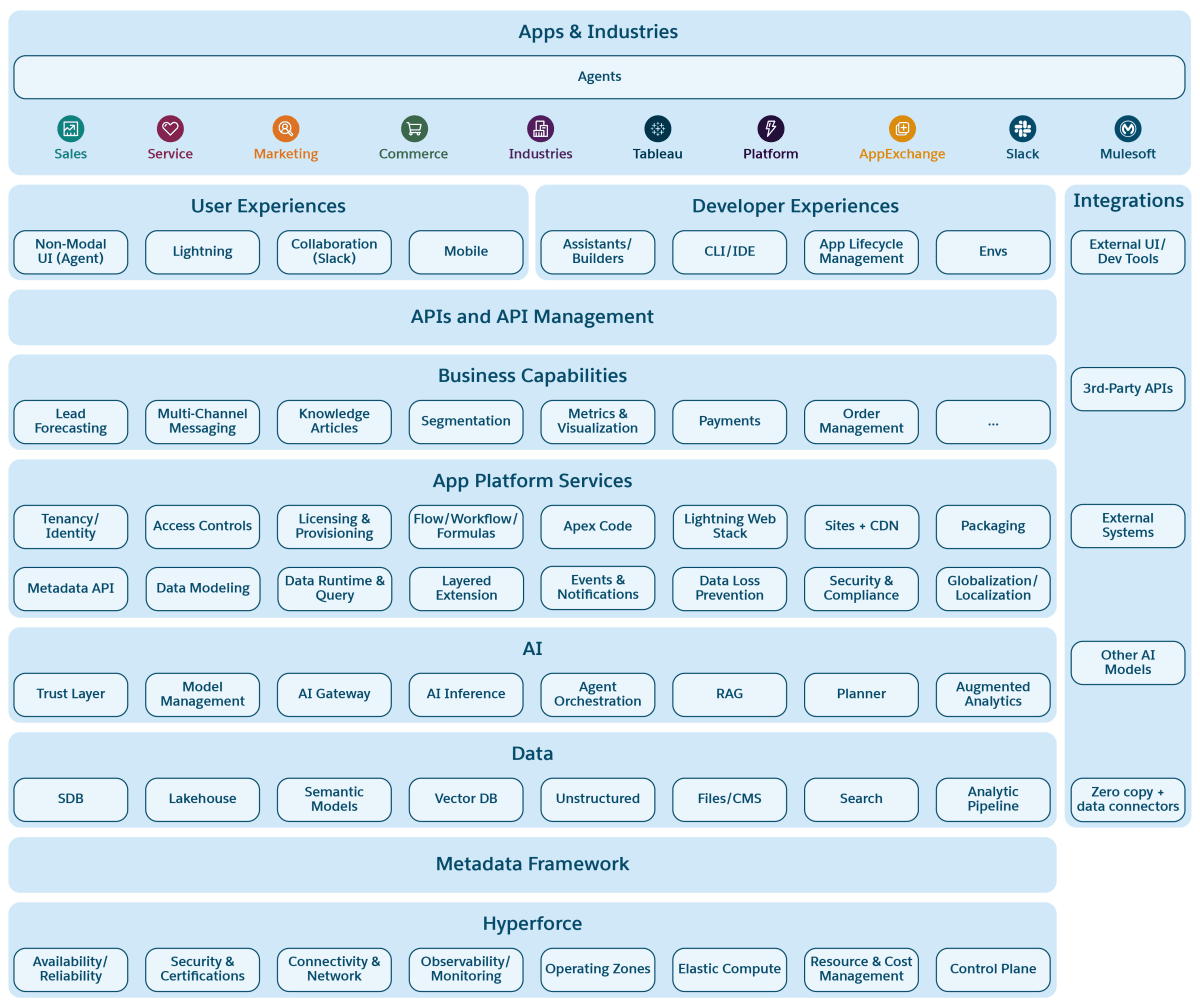
Full detail in Salesforce's own platform architecture whitepaper, if you want the ten-layer version in depth.
3. 🔑 The Packaging Puzzle: Four Categories Every Practitioner Should Know#
Here's the thing that trips up even experienced admins: not every "cloud" is licensed the same way. Some are entirely standalone. Some come bundled with other clouds inside them. Some are add-ons that require a base product you buy separately. And some aren't seat-licensed clouds at all — they're infrastructure you consume.
Once you can sort any Salesforce product into one of these four buckets, the whole catalog stops being a wall of names and starts being a map:
| Category | Meaning | Example |
|---|---|---|
| Independent | Standalone SKU, doesn't require or include another cloud | Commerce Cloud, Tableau, Slack |
| Bundled | Own SKU, but ships another cloud inside it | Health Cloud (includes Sales + Service) |
| Add-on | Extends a base cloud you must already own | Field Service (requires Service Cloud) |
| Platform service | Infrastructure or consumption credits, not a seat license | Data 360, Hyperforce |
The cleanest illustration of why this matters is Field Service. The standard Dispatcher and Technician licenses are add-ons — they require at least one Service Cloud license already in your org. But there's a separate SKU, Field Service Plus, that's bundled — it includes the Service and Sales functionality inside it. Same product family, two completely different licensing relationships, depending on which SKU you're looking at.
You can run any product through this decision tree to sort it:
flowchart TD
    Q{"❓ Does it require or<br/>include another cloud?"}
    Q -->|No| A["🟢 Independent"]
    Q -->|"Yes — included in the SKU"| B["🔵 Bundled"]
    Q -->|"Yes — buy it separately"| C["🟠 Add-on"]
    Q -->|"Neither — it's infrastructure"| D["🟣 Platform Service"]

    style Q fill:#f8fafc,stroke:#475569,stroke-width:2px,color:#0f172a
    style A fill:#f0fdf4,stroke:#16a34a,stroke-width:2px,color:#052e16
    style B fill:#eff6ff,stroke:#2563eb,stroke-width:2px,color:#172554
    style C fill:#fff7ed,stroke:#ea580c,stroke-width:2px,color:#431407
    style D fill:#faf5ff,stroke:#9333ea,stroke-width:2px,color:#3b0764
Keep this taxonomy in your back pocket as we go through the catalog — every product below gets tagged with one of these four labels.
4. 💼 The Horizontal Core: Clouds Any Business Can Buy#
"Horizontal" products aren't tied to an industry — a bank, a hospital, and a shoe retailer could all license the same one. These are the clouds most practitioners cut their teeth on.
| Cloud | Packaging | What it adds |
|---|---|---|
| Sales Cloud (Agentforce Sales) | Independent | Lead/Opportunity/Forecast model, pipeline management |
| Service Cloud (Agentforce Service) | Independent | Case management, Knowledge, Omni-Channel routing |
| Field Service | Add-on (needs Service Cloud) | Work Orders, Service Appointments, scheduling engine, offline mobile app |
| Field Service Plus | Bundled (includes Service + Sales) | All of the above, base CRM included |
| Commerce Cloud | Independent | Storefront, catalog, cart, checkout |
| Experience Cloud | Add-on (needs base CRM) | Portal/site builder, external user licenses |
| Marketing Cloud Engagement | Independent | Journey Builder, Email Studio, its own contact model |
| Marketing Cloud Account Engagement (formerly Pardot) | Add-on (needs Sales Cloud) | B2B lead nurture and scoring |
| Agentforce Revenue Management (formerly Revenue Cloud) | Add-on (needs Sales Cloud) | Product catalog, pricing engine, quote-to-cash |
| Salesforce Scheduler | Add-on (needs base CRM) | Appointment booking, distinct from Field Service |
| Loyalty Management | Add-on (needs base CRM) | Loyalty programs, tiers, vouchers |
A couple of these deserve a beat of extra attention.
Revenue Management is the product formerly known as Revenue Cloud, and before that Revenue Cloud Advanced — the newer, natively-built successor to legacy Salesforce CPQ. If you're on classic CPQ, you should know it entered End of Sale in March 2025: existing customers keep running it and keep getting support, but Salesforce isn't selling new licenses or building new features for it anymore.1 Nothing breaks today, but the product roadmap has moved on.
Salesforce Scheduler and Field Service get confused constantly because both involve booking things — but Scheduler is about appointments (a bank customer booking a meeting), while Field Service is about dispatching a mobile workforce with parts, skills, and routes. Different data models, different problems.
5. 🏥 The Vertical Layer: Industry Clouds Built the Same Way#
"Vertical" products are industry-specific — only a hospital licenses Health Cloud, only a bank licenses Financial Services Cloud. But architecturally, every single one of them follows an identical pattern: own SKU, Sales Cloud and Service Cloud of the same edition bundled inside, plus an industry-specific data model on top.
| Industry Cloud | What the industry layer adds |
|---|---|
| Financial Services Cloud | Client/Household model, Financial Accounts, Goals |
| Health Cloud | Patient records, Care Team, Care Plan, EHR integration framework |
| Life Sciences Cloud | Healthcare provider model, clinical trial management |
| Manufacturing Cloud | Sales Agreements, account-based forecasting |
| Consumer Goods Cloud | Retail visit execution, order capture |
| Automotive Cloud | Vehicle, Driver, and Dealer data models |
| Communications Cloud | Product catalog, subscriber lifecycle management |
| Energy & Utilities Cloud | Premise/meter model, service move-in and move-out |
| Public Sector Solutions | Licensing, permitting, case management for government |
| Nonprofit Cloud | Program management, fundraising, gift entry |
| Education Cloud | Admissions, student success, advancement |
That's a lot of clouds sharing one blueprint. Several of them — Communications, Financial Services, Health, Life Sciences, Media, and Energy & Utilities — also carry an entitlement to OmniStudio, the low-code toolkit (FlexCards, OmniScripts, Integration Procedures) originally built by Vlocity for exactly these kinds of guided, multi-step industry transactions.
6. ⚙️ Platform Services: The Infrastructure Nobody Licenses Per Seat#
Not everything in the Salesforce ecosystem is a "cloud" you assign to users. Some of it is infrastructure, consumed rather than seated.
Data 360 — the unified data and identity layer described in Section 2. Consumption is credit-based rather than per-user.
Agentforce 360 Platform — the agent-building and reasoning layer, also consumption-priced (Salesforce calls the unit "Flex Credits").
Headless 360 / MCP — a newer capability that exposes Salesforce data, flows, and Apex actions to any AI tool that speaks the Model Context Protocol, so an external assistant can query and act on your org through a governed, permission-respecting API rather than the UI.
Hyperforce — the public-cloud infrastructure layer Salesforce runs on today; more below.
Heroku — managed application hosting, commonly used for custom services that don't belong on the core platform.
MuleSoft Anypoint — the enterprise integration platform, for connecting Salesforce to everything that isn't Salesforce.
Slack — increasingly positioned as the conversational front door to the whole ecosystem, not just a chat tool.
Tableau / Tableau Next — the analytics layer, converging with what used to be called CRM Analytics.
None of these get a license you hand to a new hire the way you'd hand them a Sales Cloud license. They're consumed by the clouds and by your architecture, not by individual users.
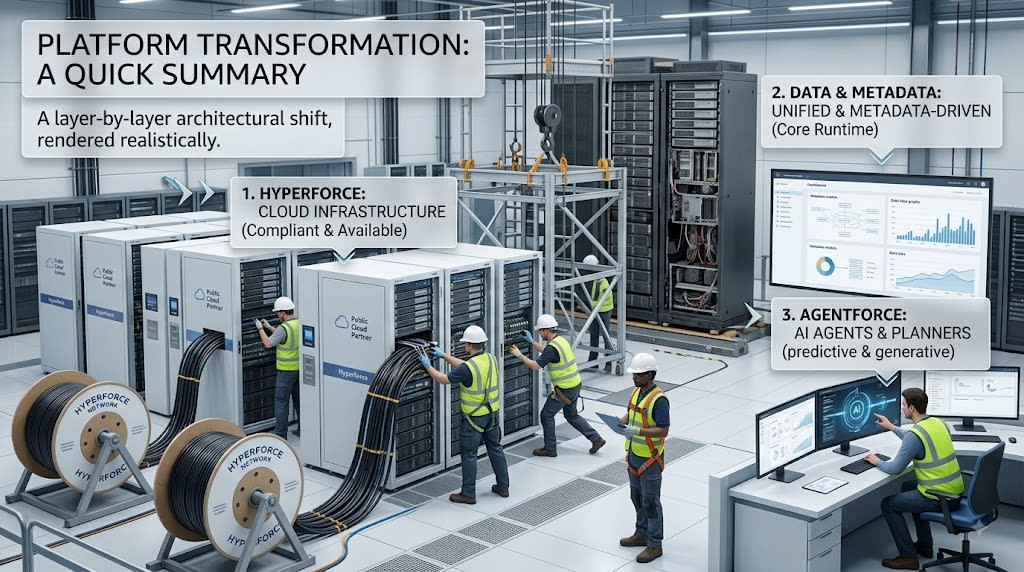
🏗️ From First-Party Data Centers to Hyperforce#
Before Hyperforce, Salesforce ran on what it calls First-Party Data Centers — physical hardware Salesforce owned and operated directly. Hyperforce is the public-cloud successor, and it's not just a change of address. Several real architectural pieces changed underneath it — and each one is a genuine improvement, not just a change of scenery:
| <br /> | First-Party Data Centers | Hyperforce | Why it matters |
|---|---|---|---|
| Delivery model | Physical hardware, manually provisioned | Infrastructure as code (Kubernetes, Service Mesh) | New regions and features ship without hardware lead time — rollouts are faster and more consistent |
| Security model | Perimeter-based | Zero-Trust — mutual TLS, short-lived certs, just-in-time access | Every service-to-service call is authenticated on its own, not just the outer edge — a compromised service can't quietly reach everything behind the perimeter |
| Scaling unit | Salesforce instance / POD | Hyperforce Cell (grouped into Supercells) | A cleaner, smaller failure boundary — problems in one cell stay contained instead of spreading org-wide |
| Redundancy | No standard AZ-level replication | Replicated across at least 3 Availability Zones per instance | A full data-center outage doesn't take your org down with it — this is a straightforward availability upgrade, not a trade-off |
| Provider model | Salesforce-owned only | Portable across AWS, Google Cloud, and Azure | Enables real data-residency choices by country/region, and avoids single-vendor lock-in at the infrastructure layer |
| Operations | Team-specific tooling | Standardized observability and AIOps by default | Incidents get detected — and often auto-remediated — before a human even needs to look, across every service consistently |
What Hyperforce did not change: the metadata framework, the Apex/Flow runtime, and the core data model all sit in layers above it. Those are related transformations happening on their own timelines — enabled by the move to Hyperforce, but not caused by it.
🌉 Does Your Org Need to Finish Migrating First?#
Not exactly — and this is where most explanations get muddy, because "does this depend on Hyperforce" is actually two different questions.
Question one: is Data 360 or Agentforce itself dependent on Hyperforce? Yes, unconditionally. These services only exist as Hyperforce-native — there's no legacy-data-center version to fall back to. They're built directly on AWS underneath, by design, from day one.
Question two: does your org need to have already finished its own Hyperforce migration before you're allowed to turn them on? No. Your core CRM — Sales Cloud, Service Cloud, your custom objects — can still be sitting on legacy first-party data centers, and you can still provision Data 360 and Agentforce today.
Think of it like a company building a new AI research wing next to its old main office. The new wing was only ever built with modern construction — there was never an option to build it the old way, so it's completely dependent on that construction method existing. But the old main office doesn't need to be demolished and rebuilt before the new wing can open. The two buildings stand side by side, connected by a bridge, each on its own foundation.
| Question | Answer |
|---|---|
| Does Data 360 / Agentforce require Hyperforce to exist and run? | Yes — always, no exceptions |
| Does your org's core CRM need to be migrated first? | No — they provision on their own Hyperforce/AWS instance regardless |
| Can an org on legacy infrastructure adopt Agentforce today? | Yes — this is exactly what's happening for most of the still-migrating minority |
7. 🔄 The Great Rename: Same Product, New Name#
If you stepped away from Salesforce for even a year and came back, you'd be forgiven for thinking half the portfolio got replaced. It didn't — it got renamed, repeatedly, as the underlying strategy shifted toward data unification and then agentic AI.
| You might know it as | It's now called |
|---|---|
| Data Cloud (and before that, Genie, and before that, CDP) | Data 360 |
| Revenue Cloud / Revenue Cloud Advanced | Agentforce Revenue Management |
| Pardot | Marketing Cloud Account Engagement |
| Vlocity | Salesforce Industries / OmniStudio |
| Einstein Analytics / Wave / Tableau CRM | CRM Analytics, converging into Tableau Next |
| MapAnything | Salesforce Maps |
| ExactTarget | Marketing Cloud Engagement |
Keeping this table nearby saves real time — searching for "Data Cloud pricing" and finding nothing current, or wondering why a colleague keeps saying "Revenue Cloud" when your contract says something else, both trace back to the same cause: the product didn't disappear, it just got a new name attached to the next strategic chapter.
8. ✅ A Field Guide: Questions to Ask Before You License Anything#
Before you request a new cloud, renew a contract, or diagnose why your org has licenses nobody remembers buying, run through this:
Does this SKU already include Sales Cloud or Service Cloud underneath it? (Check before adding either separately.)
Is this an add-on that requires a base license I need to confirm I actually have?
Is this a platform service (consumption-based) rather than a per-seat license — and do I understand the credit/consumption model before committing?
Has this product been renamed since I last checked documentation or pricing? (See the rename table above.)
If our org isn't fully on Hyperforce yet, are integrations and CI/CD tooling using My Domain rather than hardcoded IPs or POD numbers?
For anything built on legacy CPQ: has this been reassessed against Agentforce Revenue Management, given CPQ's End of Sale status?
Am I checking Salesforce's own Product & Feature Retirements page rather than a two-year-old blog post?
None of these require deep architecture knowledge — they're just the habit of asking "what's actually underneath this SKU" before you sign, configure, or troubleshoot.
9. 🎯 The Takeaway#
The Salesforce ecosystem isn't confusing because it's badly designed — it's confusing because it's genuinely large, and because Salesforce keeps renaming things as strategy shifts. But underneath the name changes, the shape has stayed consistent: one platform, one data layer, one agentic layer, and a catalog of clouds that are either independent, bundled, add-ons, or infrastructure.
Once you can place any product Salesforce announces into that structure, you stop needing to memorize the catalog. You just need the map. 🚀
Footnotes
-
Salesforce has not published an official end-of-life date for CPQ as of this writing. Some partners report extended critical-bug-fix support into 2027, but treat that as informal guidance rather than a confirmed Salesforce commitment — check your account team for anything contract-specific. ↩